Raleigh's 2026 combined property tax rate is $0.9091 per $100 of value: Wake County $0.5371, city $0.372. Pay by Jan. 5, 2027. Tax office: 919-856-5400.
Last checked Oct. 11, 2026. Updated each year when the new rates are set. Facts on this page come from Wake County Tax Administration.
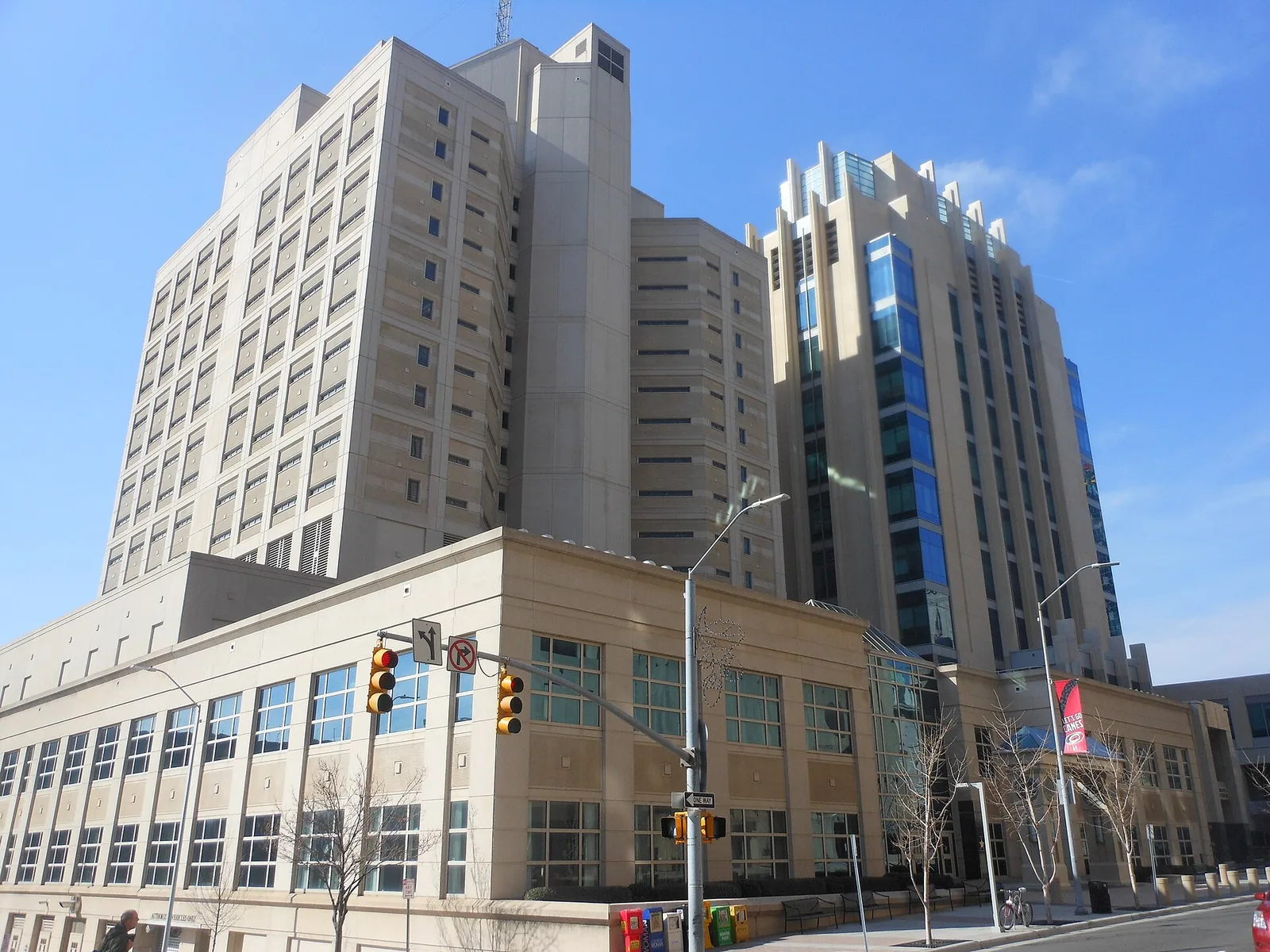
Wake County Tax Administration values property and sends one bill that covers both the county and the City of Raleigh, according to the county’s 2026 property tax bills page. The office is in the Wake County Justice Center, 301 S. McDowell St., Suite 3800, open 8:30 a.m. to 5 p.m. Monday through Friday except county holidays.
Who to call
- Bills, payments, values and relief programs: Wake County Tax Administration, 919-856-5400, taxhelp@wake.gov
- 2027 revaluation questions: 919-857-3800, revaluation@wake.gov
- Find or pay a bill: Wake County tax bill search and online payments
- Online help center: taxhelp.wake.gov
- Mail: P.O. Box 2331, Raleigh, NC 27602
The 2026 rate
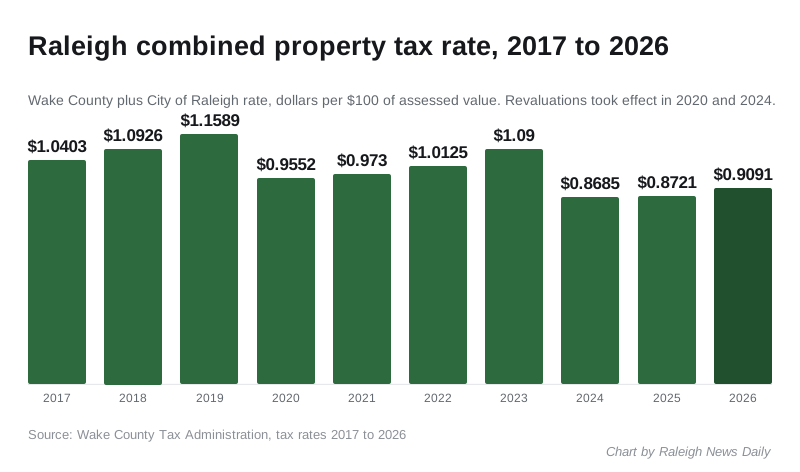
The Wake County Board of Commissioners adopted a $2.28 billion budget for fiscal 2027 on June 1, with a 2-cent increase that raised the county rate to 53.71 cents per $100 of value, the county said. It estimated the owner of a $450,000 home would pay $90 more. The Raleigh City Council raised the city rate to 37.2 cents, according to the county’s table of rates since 2017.
| Taxing unit | 2026 rate per $100 | 2025 rate per $100 |
|---|---|---|
| Wake County | $0.5371 | $0.5171 |
| City of Raleigh | $0.3720 | $0.3550 |
| Raleigh total | $0.9091 | $0.8721 |
On a home assessed at $450,000, that is about $2,417 to the county and $1,674 to the city, $4,091 in all, before any exclusion. Raleigh properties may also be in a special tax district, which the county marks with a footnote in its rate table. The same table lists a $30 City of Raleigh vehicle fee.
How the rate has moved
When the bill is due
Owners who pay through a mortgage escrow account do not get a paper bill and can look it up online. You can pay in installments of any amount or frequency without asking first, as long as the bill is paid in full by Jan. 5, 2027, the county says on its payment page. After that, interest and collection costs are added, and state law lets the county take past due taxes from wages, bank accounts or rent.
- Online by eCheck: no fee.
- Card or digital wallet: online, with a processing fee charged by the payment company.
- In person: the Justice Center office, or the county’s regional centers.
- By mail: write the account number on the check.
Worried about paying by Jan. 5? The county sets up short-term payment plans if you call before the bill is overdue.
How to appeal your value
Real estate values still reflect the market on Jan. 1, 2024, the date of the last countywide revaluation. Changes in the market since then, or a change in the tax rate, cannot be used to lower a value, according to the county’s appeals page.
- Ask for an informal review by the tax office.
- File a formal appeal with the Board of Equalization and Review, a board of county residents appointed by the commissioners. Appeals must be received before the board adjourns, usually in early to mid-April.
- If you still disagree, apply to the N.C. Property Tax Commission within 30 days after the board mails its decision.
Vehicle value appeals must be postmarked within 30 days of the due date on the notice and go to taxhelp@wake.gov with a bill of sale, dealer appraisal or repair estimate.
The 2027 revaluation
Every Wake County property gets a new value effective Jan. 1, 2027. The county plans to present results to commissioners Jan. 19, 2027, and mail new values a few days later, with appeal instructions. After that, revaluations move to every two years. Read our report on the 2027 revaluation hearing and the county’s revaluation page.
Tax relief for seniors, disabled owners and veterans
North Carolina offers three programs, and you can use only one, according to the county’s tax relief page:
- Senior and disabled exclusion: age 65 or older, or totally and permanently disabled, on Jan. 1, with 2025 income up to $38,800. Excludes $25,000 or up to 50% of the home’s value, whichever is greater. Apply once.
- Circuit breaker deferment: same age or disability rule, income up to $58,200, and five years owning and living in the home. Caps the bill at 4% or 5% of income; the rest is deferred. Apply every year.
- Disabled veteran exclusion: excludes up to $45,000 of value for an honorably discharged veteran with a total and permanent service-connected disability, or an unmarried surviving spouse. No age or income limit.
The deadline is June 1. For 2026, the county accepts late applications for good cause through Dec. 31, 2026.
What this means for you
- Your 2026 bill is due without interest through Jan. 5, 2027.
- New values arrive in late January 2027. Read the notice and note the appeal deadline.
- Check whether you qualify for relief before June 1, 2027.
Recent sales are in our weekly real estate transfers column. More on homes: Raleigh home prices.
Frequently asked questions
What is the property tax rate in Raleigh?
For 2026 a Raleigh property pays the Wake County rate of $0.5371 and the City of Raleigh rate of $0.372 per $100 of assessed value, $0.9091 in all. Some downtown properties also pay a special district tax.
When are Wake County property taxes due?
Bills for 2026 can be paid without interest through Tuesday, Jan. 5, 2027. Partial payments in any amount are allowed as long as the balance is paid by then.
How do I appeal my property value in Wake County?
Real estate appeals go to the Board of Equalization and Review, and must be received before the board adjourns, usually in early to mid-April. Values now reflect the Jan. 1, 2024, revaluation.
When is the next Wake County revaluation?
The next countywide revaluation takes effect Jan. 1, 2027. The county plans to mail new values after Jan. 19, 2027, and then revalue every two years starting in 2029.
Do seniors get a property tax break in Wake County?
Homeowners 65 and older or totally and permanently disabled with 2025 income up to $38,800 can exclude $25,000 or up to half of their home’s value, whichever is greater. The deadline is June 1.
Have your say