Raleigh elects a mayor and seven council members Tuesday and decides two $101.5 million bonds. Polls are open 6:30 a.m. to 7:30 p.m. Here is every city contest.
Raleigh voters choose a mayor and all seven City Council members on Tuesday, Nov. 3. They also decide two city bonds worth $101.5 million each, one for housing and one for transportation.
Polls are open from 6:30 a.m. to 7:30 p.m. Tuesday. Wake County’s last day of early voting is today, Saturday, Oct. 31, with sites open from 8 a.m. to 3 p.m. Voters in line by 3 p.m. can still vote, the county said in its early voting release.
Who is on the city ballot
The city races are nonpartisan, so no party appears next to these names. The candidates below are listed as they appear in the North Carolina State Board of Elections candidate list for Wake County.
| Contest | Candidates | Term |
|---|---|---|
| Mayor | Ashleigh Heath Armstrong, Janet Cowell | 4 years |
| Council at-large (vote for two) | Joshua Bradley, Stormie Denise Forte, Clark Rinehart, Sana Siddiqui | 4 years for first place, 2 years for second |
| District A | Whitney Hill, Mitchell Silver | 4 years |
| District B | Megan Patton (unopposed) | 4 years |
| District C | Corey Branch, Jared S. Ollison | 2 years |
| District D | Jane Harrison, Jevon Smith-Cook | 2 years |
| District E | Christina Jones, Marc Scruggs | 2 years |
The at-large field and District C were narrowed in the March 3 primary. Six candidates had filed for the two at-large seats and four for District C, the state’s candidate file shows.
Why some terms are two years
This is the first election under the council’s move to four-year terms, adopted in 2024. To stagger the seats, the city’s Vote Local page sets out how this year works:
- The mayor and the District A and B members win four-year terms.
- The at-large candidate with the most votes wins a four-year term.
- The second-place at-large candidate wins a two-year term.
- Districts C, D and E are two-year terms, and those seats return to the ballot in November 2028 for four-year terms.
From 2030, half the council will be elected every four years, the city said.
The two bond questions
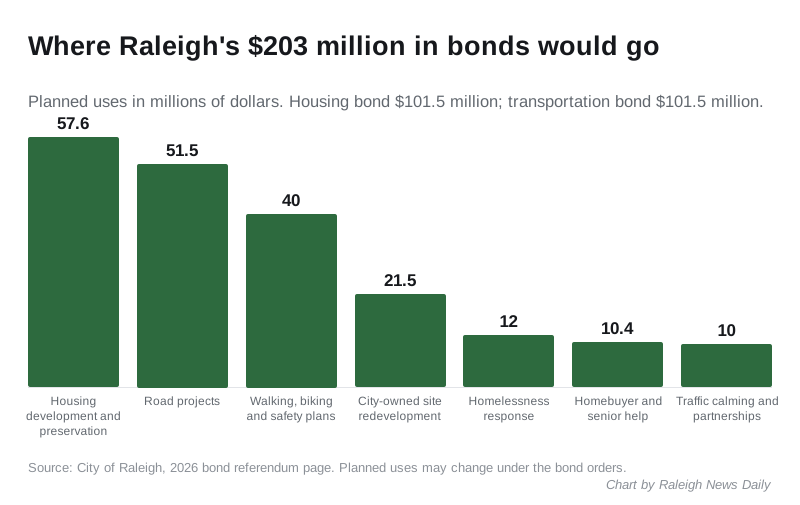
The City Council adopted the two bond orders May 19, putting up to $203 million in borrowing on the ballot. Voters answer each question separately. The details come from the city’s 2026 bond referendum page.
Housing bond, $101.5 million:
- $57.6 million for building new affordable housing and preserving existing affordable homes
- $21.5 million held for major redevelopment of city-owned sites
- $12 million for homelessness response, including Wake at Home, a public-private partnership coordinated by the Wake County Continuum of Care
- $10.4 million for homebuyer help and programs that help seniors stay in their homes, for buyers earning at or below 80% of area median income
Transportation bond, $101.5 million:
- $51.5 million for three road projects: Marsh Creek Road and Trawick Road-West, Ebenezer Church Road, and general-purpose lanes along the Southern Bus Rapid Transit corridor that federal money cannot pay for
- $40 million for council-adopted plans, including the “Big Jump” program of more than 5 miles of sidewalks and 50 miles of bikeways over five years, and the city’s safety action plan
- $10 million for the Neighborhood Traffic Management Program, which pays for traffic calming and intersection safety, and for partnerships on projects already planned
The city said these are planned uses and may change within the limits of the bond orders.
What the bonds would cost taxpayers
The city said the bonds would not require a property tax increase. The ballot disclosure puts the direct tax impact at “$0 (zero dollars).”
Both ballot questions still say “additional taxes may be levied” to repay the bonds. The city said that wording is standard language set by the state legislature.
Also on Raleigh ballots
Depending on where you live, your ballot also carries federal, state and county races. They include the U.S. Senate, U.S. House, state legislative seats, Wake County commissioners, sheriff, clerk of Superior Court and four Wake County Board of Education districts. Your own sample ballot is on the state’s voter lookup.
What it means for you
- Vote at your own polling place. On Election Day you must vote at your assigned precinct, which may not be where you voted early. Look it up on the voter lookup.
- Bring a photo ID. A North Carolina driver’s license is the most common, and other forms are accepted. Without one you can vote a provisional ballot and fill in a Photo ID Exception Form, the county said.
- Absentee ballots must reach the Wake County Board of Elections by 7:30 p.m. Tuesday, with no exceptions. Drop boxes are not allowed. You can hand a ballot in at an early voting site through 3 p.m. today.
- Questions: the Wake County Board of Elections at 919-404-4040 or voter@wake.gov.
Registration, early voting and polling place details are on our voting page. Who does what at City Hall is on our city hall contacts page.
Have your say